CM Siddaramaiah Tables Record 17th Budget, Unveils ‘11G Karnataka Model’ Balancing Welfare, Growth and Fiscal Discipline
Chief Minister presents historic 17th Budget outlining a people-centric economic roadmap — from guarantee schemes and farmer support to education, health and infrastructure — while flagging revenue pressures from GST changes and reduced central tax share.
 OOB News Desk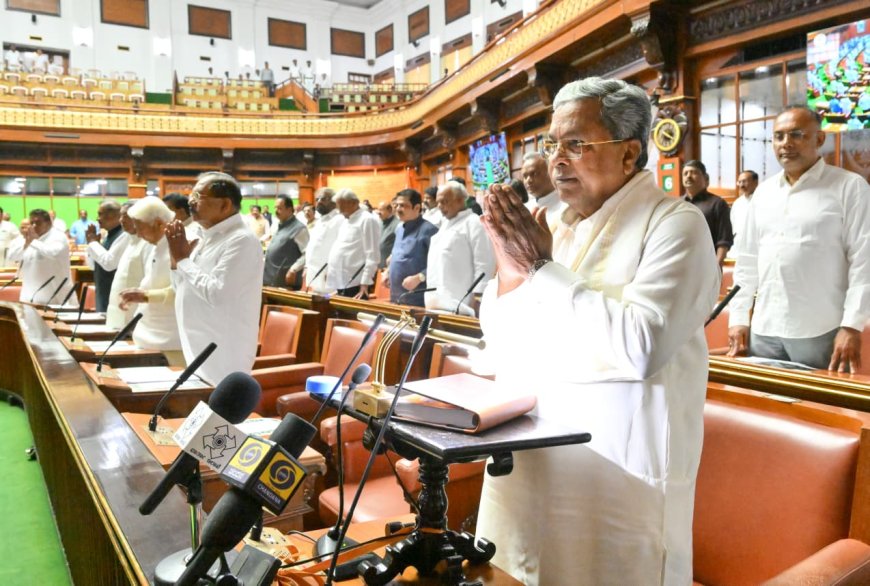
Bengaluru | March 6
Chief Minister Siddaramaiah on Friday presented Karnataka’s record 17th Budget, positioning it as a people-centric economic blueprint that seeks to balance welfare guarantees, economic growth and fiscal discipline while navigating revenue pressures caused by GST restructuring and reduced tax devolution from the Union Government.
Calling the budget a “live document reflecting the aspirations of seven crore Kannadigas,” Siddaramaiah said the government’s fiscal priorities remain centred on farmers, workers, women, youth, students, minorities and vulnerable sections of society.
“This budget echoes the dreams and confidence of farmers, marginalized sections, workers, women and youth,” the Chief Minister said while presenting the financial statement in the Assembly.
The government, he said, is pursuing a development path that combines social justice, economic expansion and regional balance.
Karnataka Model: The 11G Economic Framework
At the core of the 2026-27 Budget is what Siddaramaiah described as the “11G Economic Model”, a framework designed to guide Karnataka’s long-term development strategy.
The model is built around eleven pillars:
Guarantee Economy
Good Public Education
Good Health to All
Grassroots Economy
Good Governance
Gig Economy
Geographical Equality
Global Trade Economy
Globe-Trotting Economy (tourism-led growth)
Green Economy
Growing Urban Economy
According to the Chief Minister, the model aims to combine welfare expansion with economic transformation while ensuring that development benefits reach every region and social group.
The budget also emphasises the idea that economic growth must be accompanied by investment in human development, highlighting education, health and social welfare as central pillars of the state’s growth strategy.
Karnataka Economy Outpacing National Growth
Highlighting the state’s economic performance, Siddaramaiah said Karnataka recorded 8.1 percent real GSDP growth in 2025-26, higher than the national growth rate of 7.4 percent.
Agriculture grew by 9.1 percent, industry by 6.7 percent, while the services sector recorded 8.1 percent growth, reflecting a balanced expansion across sectors.
Karnataka also attracted USD 9.4 billion in foreign direct investment during the first half of 2025-26, accounting for nearly 27 percent of India’s total FDI inflows, reinforcing its position as one of the country’s most attractive investment destinations.
The state continues to lead the country in sectors such as information technology, biotechnology, aerospace, electronics, start-ups and advanced manufacturing, the Chief Minister said.
Fiscal Pressures and Centre–State Issues
Despite strong economic performance, the Chief Minister warned that fiscal pressures are mounting due to GST rate rationalisation and changes in central tax devolution.
The restructuring of GST rates has resulted in an estimated ₹10,000 crore revenue loss in the current financial year and ₹15,000 crore next year for Karnataka.
Siddaramaiah also reiterated the state’s long-standing concern regarding reduced tax devolution under the Fifteenth Finance Commission, which lowered Karnataka’s share in the divisible pool of central taxes.
However, the Sixteenth Finance Commission has recommended increasing the state’s share, which the government described as a partial correction of the earlier imbalance.
The Chief Minister called for stronger cooperative federalism, saying the development of high-performing states like Karnataka must be supported rather than constrained.
Guarantee Schemes Continue
Defending the government’s flagship guarantee schemes, Siddaramaiah said they have significantly improved household purchasing power and provided economic security to millions of families.
Since their launch in 2023, the government has spent over ₹1.21 lakh crore on the guarantees, while maintaining fiscal discipline with the fiscal deficit kept within 3 percent of GSDP.
Under the Gruha Lakshmi scheme, which provides monthly financial assistance to women heads of households, ₹62,345 crore has been disbursed to 1.24 crore beneficiaries so far.
The government said these schemes have strengthened the rural economy by boosting consumption and financial stability for households.
Agriculture and Rural Economy Focus
Agriculture continues to be a major focus of the budget, with the government outlining a four-pillar strategy covering:
scientific farming guidance
financial support to farmers
improved agricultural inputs
post-harvest infrastructure and market linkages
Over the past three years, the government has distributed seeds worth ₹468 crore to more than 40 lakh farmers, provided crop loans of ₹70,000 crore, and settled crop insurance claims worth ₹6,213 crore covering 51 lakh farmers.
The budget proposes a Chief Minister’s Krishi Vistara Scheme to strengthen agricultural value chains and increase farmers’ income through processing, value addition and market access.
Millet promotion, organic farming and climate-resilient agriculture are also key priorities.
Education and Youth Development
Major investments have been announced to strengthen public education.
Among the key initiatives:
800 schools will be upgraded as Karnataka Public Schools under a ₹3,900-crore programme.
15,000 teacher posts will be filled in 2026-27.
AI-based personalised digital learning tools will be introduced for over 12 lakh students.
The government also plans to expand higher education infrastructure, create centres of excellence and introduce new courses in emerging fields such as artificial intelligence, machine learning and automation engineering.
Healthcare Expansion
The government has earmarked ₹900 crore for health infrastructure development, including the upgrading of hospitals and expansion of trauma care facilities.
The Ayushman Bharat–Arogya Karnataka scheme will be strengthened with revised treatment packages to improve access to quality healthcare for poor patients.
Several new medical colleges, super-speciality hospitals and regional healthcare centres are also planned across the state.
Social Justice and Welfare
Continuing Siddaramaiah’s long-standing emphasis on social justice, the budget allocates ₹44,632 crore under the Scheduled Caste Sub-Plan and Tribal Sub-Plan.
Scholarships worth ₹2,676 crore have been provided to 75 lakh students belonging to disadvantaged communities, while infrastructure development continues in SC, ST and minority colonies across the state.
The government is also expanding residential schools, hostels and skill programmes aimed at improving access to education and employment opportunities for marginalized communities.
A Political and Fiscal Milestone
The 2026-27 budget also marks a significant political milestone for Siddaramaiah, who now holds the record for presenting 17 Karnataka budgets across different tenures as Finance Minister and Chief Minister.
His budget journey spans nearly three decades, beginning with his first stint as Finance Minister in the mid-1990s, followed by a second phase in the mid-2000s, six budgets during his first tenure as Chief Minister from 2013 to 2018, and the current series after returning to power in 2023.
Across these phases, Siddaramaiah’s budgets have consistently reflected a strong focus on social justice, backward-class empowerment, farmer support and welfare-led development.
With this record-setting budget, the Chief Minister once again used the state’s most important policy platform to articulate what he calls a people-centric development model — one that seeks to combine welfare guarantees with long-term economic transformation.