Drones Redefine Governance: From Village Maps to Border Security, India Builds a Sky-Driven Revolution
With 38,500+ registered drones and nearly 40,000 certified pilots, India’s drone ecosystem powers agriculture, infrastructure, disaster response, and defence through bold reforms and inclusive innovation
 OOB News Desk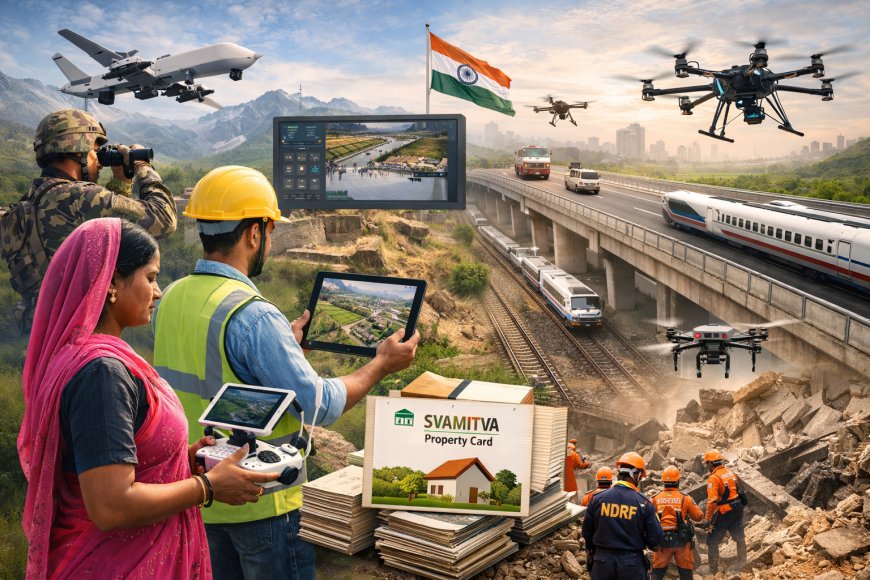
New Delhi, February 17:
India’s rapidly expanding drone ecosystem is emerging as a powerful engine of governance reform and socio-economic transformation, with unmanned aerial systems now embedded across agriculture, land records, infrastructure monitoring, disaster management, and national security.
According to data released by the Government of India, as of February 2026, the country has registered more than 38,500 drones, issued 39,890 Remote Pilot Certificates, and approved 244 training organisations under the supervision of the Directorate General of Civil Aviation. This regulated framework has laid the foundation for a nationwide, technology-driven public service ecosystem.
From Pilot Projects to Public Platforms
Over the past two decades, drone technology in India has evolved from limited experimental use to a structured national system involving manufacturers, service providers, training institutions, startups, and research bodies. Supported by simplified regulations and digital platforms, drones are now central to governance delivery and infrastructure management.
Progressive reforms, including liberalised Drone Rules, the Digital Sky platform, and skill development initiatives, have reduced compliance barriers and enabled large-scale adoption across ministries and states.
Women-Led Agriculture Gets Wings
One of the most impactful initiatives is the Namo Drone Didi scheme, launched in November 2023 to empower women Self-Help Groups (SHGs) in agriculture.
Since its inception:
* 1,094 drones have been distributed to women SHGs
* Over 500 drones were provided directly under the scheme
* Precision spraying and crop monitoring have reduced costs and improved yields
* A Drone Didi from Sitapur, Uttar Pradesh, featured in the 110th episode of Mann Ki Baat, highlighted how drone training enabled her SHG to offer paid spraying services, boosting income and social standing.
Mapping Villages, Securing Land Rights
Drone-based land mapping under the SVAMITVA Scheme has transformed rural property management.
Implemented by the Ministry of Panchayati Raj, State Governments, and the Survey of India, the initiative aims to resolve land disputes and improve credit access.
Key achievements include:
* Target coverage: 3.44 lakh villages
* Surveys completed: 3.28 lakh villages (95%)
* Property cards issued: 2.76 crore
Coverage: 1.82 lakh villages across 31 states and UTs
The programme has strengthened land governance and enhanced rural financial inclusion.
Highways, Railways Go Digital
Drones have become a vital monitoring tool in infrastructure development. The National Highways Authority of India mandates monthly drone-video recordings for all highway projects, enabling digital supervision, dispute resolution, and transparent reporting.
In the railway sector, the Ministry of Railways has directed zones to deploy UAVs for inspecting tracks, bridges, and remote locations. The Railway Protection Force uses drones for surveillance, crowd control, and anti-trespass operations.
Disaster Response from the Sky
Drones are strengthening India’s emergency preparedness. The North East Centre for Technology Application and Reach (NECTAR) has developed specialised platforms capable of long-duration flights and heavy payloads for flood and landslide monitoring.
Live aerial visuals now enable faster assessment, coordinated rescue operations, and improved disaster management outcomes.
Defence and Strategic Applications
In defence, drones play a crucial role in border surveillance, intelligence gathering, and precision strikes.
During Operation SINDOOR, Indian drones and loitering munitions neutralised enemy targets with high accuracy, working in coordination with radar and command systems to protect critical infrastructure.
Reforms Fueling Growth
India’s drone expansion is backed by comprehensive policy support:
Drone Rules, 2021 and Amendments (2022–23):
* Forms reduced from 25 to 5
* Approvals cut from 72 to 4
* 90% airspace declared Green Zone
Remote Pilot Certificates replaced traditional licences
* Passport requirement removed
Production Linked Incentive (PLI):
* ₹120 crore outlay to promote domestic manufacturing
GST Reform (2025):
* Uniform 5% GST on drones and simulators, replacing 18–28% slabs
Digital Governance:
* Registration and certification migrated to eGCA
* Operational services integrated with Digital Sky
* Building Skills and Startups
* Flagship programmes such as Bharat Drone Shakti, Bharat Drone Mahotsav, and Drone International Expo are promoting
Drone-as-a-Service models and indigenous innovation.
The SwaYaan programme has conducted over 857 activities, benefiting 26,000+ participants, while the National Innovation Challenge for Drone Application and Research (NIDAR) supports student innovation with a ₹40 lakh prize pool.
A Future-Ready Ecosystem
From empowering women farmers to digitising land records, monitoring mega infrastructure, enhancing disaster response, and strengthening national security, drones are reshaping India’s governance landscape.
With continued support for indigenous manufacturing, skill development, and strategic deployment, India is positioning itself as a global leader in unmanned aerial systems—balancing commercial growth, technological self-reliance, and inclusive development.
The country’s drone revolution, driven by policy clarity and grassroots adoption, now stands as a model for technology-led public service transformation.