Curtain Raiser to 'Kumaranna 2.0'? Bidadi Battle Puts HDK Back at the Centre of Karnataka Politics
The Bidadi farmers' agitation may be more than an issue-based protest. It could mark the beginning of a carefully calibrated political comeback by Union Minister H. D. Kumaraswamy, positioning himself as the principal challenger to Chief Minister D. K. Shivakumar ahead of the 2028 Assembly elections amid questions over the effectiveness of the BJP's state leadership.
 OOB News Desk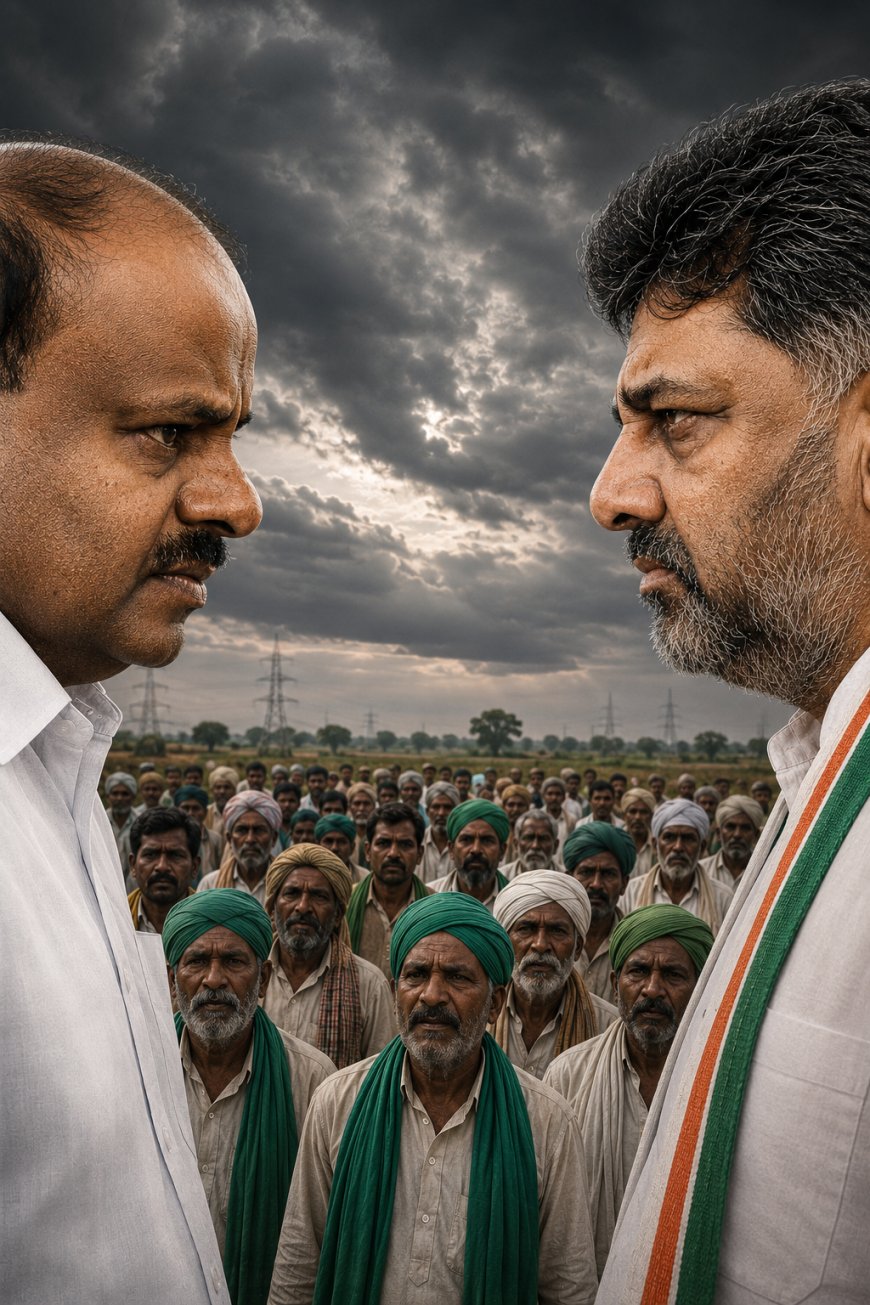
Bengaluru I June 27 :
Politics often turns not on elections, but on moments.
For nearly two years after the 2023 Assembly defeat, Kumaraswamy appeared to have shifted much of his attention to New Delhi following his induction into the Union Cabinet.
While JD(S) strengthened its alliance with the BJP, Kumaraswamy's direct involvement in Karnataka politics seemed relatively subdued.
The proposed ambitious multi-core Bidadi township project to spread across 7500 acre and the controversy surrounding it, appears to have altered that perception.
Instead of remaining a distant Union Minister, Kumaraswamy has chosen to physically return to the political battlefield—meeting farmers, writing repeatedly to the state government, challenging the Congress leadership and projecting himself as the face of the agitation.
His June 27 visit seems to be setting new political tone in the state politics, at a time BJP is struggling to project a united state leadership.
Whether intentionally or otherwise, the optics resemble the Kumaraswamy Karnataka had once known—the leader who built his political identity around direct public engagement.
From People's CM to People's Protest
Kumaraswamy earned the image of "People's CM" during his first tenure as Chief Minister (2006-07).
His governance style differed from conventional administration, which is said to be the main reason PM Modi handpicked Kumaraswamy in his cabinet assigning major portfolios.
Among the initiatives that strengthened his public image were:
* Janata Darshan, where ordinary citizens directly presented grievances before the Chief Minister.
* Frequent district tours and village interactions.
* Surprise inspections and on-the-spot decisions.
* A farmer-centric political narrative that resonated strongly in Old Mysuru and rural Karnataka.
* Quick intervention in individual hardship cases, creating an image of an accessible Chief Minister.
Even critics acknowledged that Kumaraswamy possessed an uncommon ability to connect emotionally with ordinary citizens.
That emotional politics appears to be resurfacing through Bidadi.
Bidadi: More Than Land Acquisition
The Bidadi township issue is politically significant because it combines several sensitive themes:
* Farmers versus urban expansion.
* Agriculture versus real estate.
* Local livelihoods versus mega development.
* Rural Karnataka versus Bengaluru-centric growth.
Kumaraswamy has consistently framed the issue around protecting fertile agricultural land and farmers' livelihoods, repeatedly challenging the government to engage directly with affected villagers.
For a leader whose politics has traditionally revolved around rural Karnataka, the issue provides a natural platform.
A Vacuum in the Opposition?
The political significance of Kumaraswamy's re-emergence also depends on the current opposition landscape.
The BJP remains the principal opposition numerically.
However, the party has witnessed visible public discussion over leadership, organisational direction and coordination between senior leaders and the present state leadership.
Reported differences and varying approaches involving leaders such as leader of opposition R. Ashoka and party president, B. Y. Vijayendra have frequently attracted political attention, although both have jointly participated in protests over the Bidadi issue.
This does not necessarily indicate organisational collapse, but it has fuelled political commentary that the BJP has not yet projected a single dominant state-wide face capable of matching the Congress leadership.
That creates political space.
And Kumaraswamy understands political space better than most regional leaders.
HDK Versus DK?
If Congress enters 2028 under the leadership of DK Shivakumar, the contest may gradually acquire a distinctly Old Mysuru flavour.
Both leaders:
* Draw strength from the Bengaluru Rural-Ramanagara belt.
* Have deep roots in cooperative politics.
* Understand caste arithmetic.
* Possess strong organisational networks.
* Thrive on aggressive political mobilisation.
The Bidadi issue directly places both leaders on opposite sides of the same political question.
For Kumaraswamy, this is not merely opposition politics.
It is an opportunity to define himself once again as the protector of farmers.
'Kumaranna 2.0' ?
Every major Karnataka leader has had multiple political innings.
Former PM H.D.Deve Gowda returned after setbacks.
Former CM B.S.Yediyurappa repeatedly rebuilt the BJP.
Former CM Siddaramaiah reinvented himself after leaving the Janata Parivar.
Kumaraswamy himself has repeatedly demonstrated resilience after electoral defeats.
Whether Bidadi becomes the launchpad for "Kumaranna 2.0" will depend on what follows.
Can JD(S) expand beyond its traditional base?
Can Kumaraswamy sustain statewide agitations?
Will he emerge as the principal opposition face on public issues?
Can he convert emotional mobilisation into electoral momentum?
Those answers remain uncertain.
Political Takeaway
It would be premature to conclude that Karnataka politics is heading towards a direct HDK-versus-DK contest. The BJP remains the largest opposition party in the Assembly and retains a significant organisational base.
However, the Bidadi agitation has unmistakably brought Kumaraswamy back into the centre of Karnataka's political conversation.
If he successfully transforms issue-based politics into a broader statewide campaign over the next two years, analysts may eventually look back at the Bidadi farmers' movement not merely as a land acquisition protest—but as the opening chapter of "Kumaranna Version 2.0."